








Digital Dentistry Done Right: Predictability, AI, and the Tools Defining Modern Practice
 Blog

When asked how AI will transform dental practice, Dr. Faraj Edher offers a thought-provoking comparison: "I believe that the way we will ask ourselves this question is the same way as if I were to ask you, how do you use the internet in your practice. The specifics are going to be irrelevant because the answer will be everything."
It's a fitting lens for the broader shift happening in dentistry — one Dr. Edher has spent his career helping define. A Vancouver-based prosthodontist, he is the founder of Transcend Specialized Dentistry and Transcend Lab, and the founder of the BC Dental Study Club, Canada's largest. A Fellow of the Royal College of Dentists of Canada and Clinical Assistant Professor at UBC, Dr. Edher is recognized as a leader in cosmetic dentistry, implant rehabilitation, and full-mouth restorative care. His perspective on digital workflows and AI cuts through the hype to focus on what's actually moving the needle in clinical practice today.
The Real Value: Predictability, Not Just Speed
Most conversations about digital dentistry focus on efficiency and faster turnaround. Dr. Edher sees those as secondary benefits.
"The key is not necessarily the speed. The key is not necessarily the efficiency. Those are cherries on top," he explains. "Where we've really seen a revolution when it comes to how we practice dentistry is the predictability of the clinical work that we can do."
Traditional workflows have produced excellent dentistry for over a century — and will continue to. The advantage of digital tools is that they remove the day-to-day variables that introduce inconsistency:
- How the clinician feels on a given day
- The lab technician's variability
- Errors that compound when bridging between analog and digital systems
- Guesswork around occlusal clearance, margins, and reductions
The takeaway: digital workflows don't replace skill, they protect consistency.
Two Must-Have Technologies for Restorative Dentistry
For dentists committing to a digital workflow, Dr. Edher names two non-negotiables.
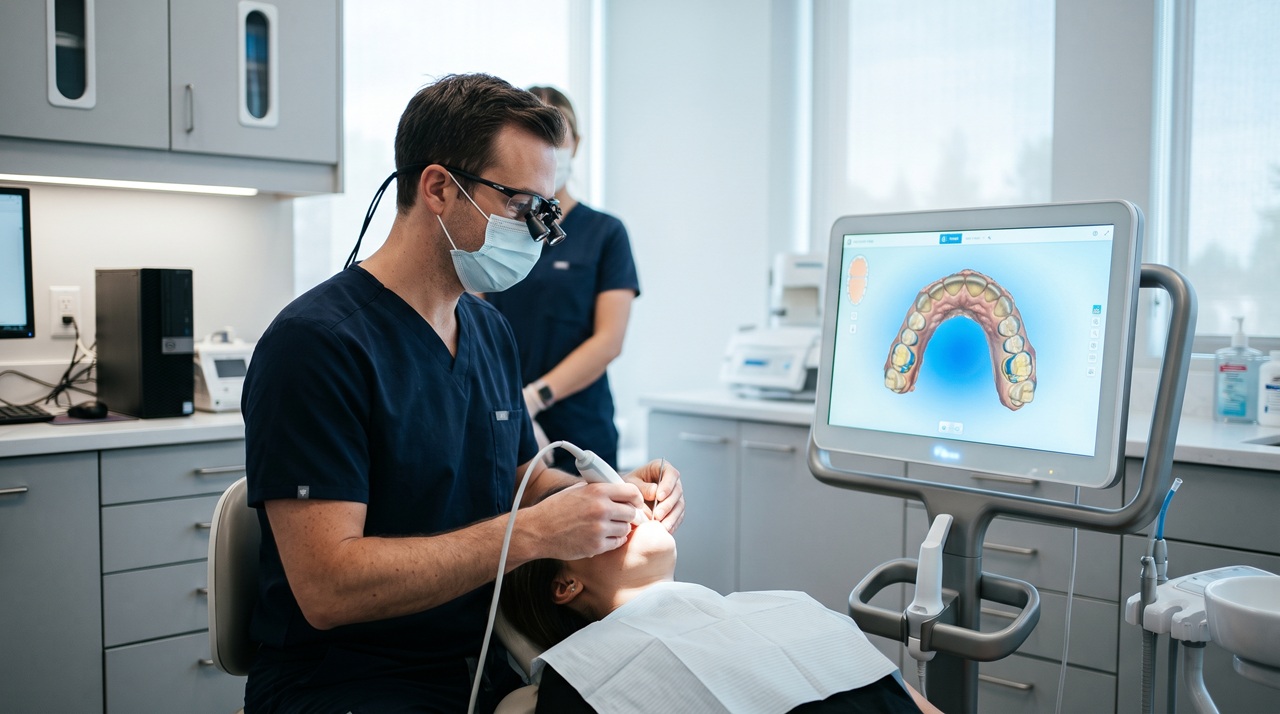
The intraoral scanner. The value isn't simply replacing PVS — it's unlocking capabilities impossible with traditional impressions. Stopping and restarting scans lets clinicians capture 10 to 14 prepped teeth in sequence. Occlusal clearance can be verified within seconds at the chair. Margins can be examined at 20x zoom before sending to the lab.
"If I can't see where my margins are, there's no reason for me to press send because I'm not going to send it to the lab for them to only guess my margin," Dr. Edher notes.
The 3D printer. Lower entry costs and faster print speeds have made 3D printing essential — particularly for implant dentistry. Printing surgical guides from digitally planned cases delivers ROI quickly, even before factoring in patient experience, recovery time, and procedural accuracy.
One critical principle for any digital adopter: stay in the digital lane. Going from PVS to scanned model to CAD/CAM introduces inaccuracies that compound. "The more we bridge back and forth between the digital and physical workflow, the more we introduce errors in that system."
The Gold Standard for Implant Dentistry
If digital workflows are valuable for restorative cases, they're essential for implants.
"Digital workflows, in my opinion, are probably safe to say the gold standard of how we should do implant dentistry today," Dr. Edher states.
The protocol he advocates is straightforward:
- Capture a cone beam CT
- Superimpose it with an intraoral scan (or scanned impression)
- Perform digital implant planning before any surgical step
- 3D print a surgical guide to execute the plan precisely
The benefits show up even when the surgery is performed freehand. Visualizing the case before flapping means problems get solved in planning, not during the procedure. The result is shorter chair time, better outcomes, smoother recoveries, and stronger case acceptance when patients see the visualization before treatment.
AI Today: From Hype to Clinical Value
AI is built into nearly every piece of new dental technology, but Dr. Edher draws a clear line between hype and current clinical value. The most practical applications today include:
- Scanner intelligence — excluding the tongue, fingers, and other artifacts in real time
- Radiographic interpretation — flagging areas worth a closer look
- Patient communication — removing the trust barrier by letting AI surface findings systematically
- Operational AI — automating routine practice tasks so the team can focus on human interactions
- Design automation — cloud-based platforms partnering with major scanner brands to design restorations with a single button press
The patient communication piece may be underappreciated. When patients see AI highlighting a concern on screen, the dynamic shifts from "do I trust this dentist?" to "let's investigate further." For new patients, this changes case acceptance immediately.
Virtual Jaw Tracking: Removing the Guesswork from Occlusion
Among today's AI applications, virtual jaw tracking stands out as a clinical game-changer — particularly for complex restorative work.
"I will say if I were to ever need a full mouth reconstruction in today's world, I would refuse to have it done without virtual jaw tracking," Dr. Edher says. "It's just that much of a game changer in terms of removing guesswork."
Two sources of error get eliminated with this technology. The first is guessing — using average articulator settings, arbitrary hinge axis openings, and approximations that later show up as occlusal adjustments at delivery. The second is manufacturing error, which digital workflows already minimize. Together, the result is dramatically less chairside adjustment for crowns, bridges, and full-mouth reconstructions.
Modern Technique Still Matters
Even with the best digital tools, technique drives outcomes. For bonded restorations like veneers, inlays, and onlays, Dr. Edher emphasizes two practices: selective etch technique paired with a universal adhesive, and immediate dentin sealing performed at the time of preparation — before contaminated dentinal tubules compromise bond strength. For non-retentive restorations especially, sealing freshly cut dentin produces a meaningfully stronger bond than waiting until delivery. A flowable base layer can be added when needed to eliminate undercuts additively, preserving tooth structure that would otherwise be removed. Dr. Edher's hands-on porcelain veneers program, developed in partnership with Ivoclar, builds these protocols into a systematic workflow taught across North America.
The Takeaway
Digital dentistry isn't about chasing the newest gadget — it's about building a workflow where predictability replaces guesswork at every step. Whether that means investing in a scanner and 3D printer, adopting guided implant protocols, integrating virtual jaw tracking, or updating bonding technique, each change reduces variables and improves outcomes.
As Dr. Edher's analogy suggests, AI will eventually be woven into clinical practice the way the internet already is. The dentists positioned to benefit most are the ones treating digital workflows as the standard — not the upgrade.